How Long Does Temp Mail Last? Complete Lifespan Guide
Every temp mail user eventually runs into the same question – is my inbox still there? Maybe you need a verification code you forgot to copy, a download link you didn’t click, or a follow-up email from a service you just signed up for.
The answer depends entirely on which service you used and how much time has passed. There is no universal lifespan for temporary email addresses – it ranges from 10 minutes to several days depending on the provider. Understanding these timeframes helps you use disposable email effectively without losing access to something important.
How Long Do Temporary Email Addresses Last?
Temp mail lifespans fall into distinct categories:
Ultra-short (10-60 minutes) – Services marketed as “10 minute mail” provide inboxes that expire quickly. Built for grabbing a single OTP or clicking one verification link. The risk: if the sending service has slow email servers, your verification may arrive after the inbox has already expired.
Session-based (tab-dependent) – Many services tie the inbox to your browser session. The inbox stays active as long as your tab is open. Close the tab, and your access ends. The inbox may still exist on the server briefly, but you can’t reach it.
Hours-based (1-48 hours) – The inbox persists for a fixed window regardless of whether your tab is open. This gives you time to complete multi-step signups, close the browser, and return within the active period. TempMail.chat falls in this category with a 24-hour inbox – enough time to handle any verification without rushing.
Days-based (2-7 days) – Some providers keep inboxes active for several days. Useful for evaluating a SaaS free trial, receiving an onboarding email sequence, or any signup where follow-up emails arrive over multiple days.
Permanent (premium plans) – A few providers offer indefinite inbox storage through paid plans. At this point it’s no longer truly temporary email – it’s an anonymous email account with permanent storage.
What Happens When Temp Mail Expires?
Expiration doesn’t happen all at once. It follows a predictable sequence:
New emails stop arriving first. The address stops accepting inbound messages. Emails sent after this point either bounce back to the sender or disappear silently. Requesting a resend won’t help – the new email has nowhere to land.
Stored emails are permanently deleted. The server purges all messages from the inbox. No backup, no archive, no server-side recovery path. This is the point of no return – the content is gone forever.
The address is recycled or deactivated. The username may eventually become available again, but re-entering the same address creates a new empty inbox – not a recovery of the old one.
Complete dissolution. The address has zero presence on the server. All metadata, logs, and cached data are cleared.
This is exactly why using temp mail for long-term accounts carries real risk – once the address expires, password recovery and account access are gone permanently.
Why Does Temp Mail Expire?
Auto-deletion isn’t a flaw – it’s the core privacy mechanism.
Privacy by deletion. The less data that persists, the less data that can be exposed in a breach, sold by a data broker, or used for tracking and behavioral profiling. An inbox that expires leaves no persistent record connecting you to that address.
Server resource management. Every inbox requires disk space, memory, and processing power. For services handling millions of disposable addresses, storing old emails indefinitely would be unsustainable. Auto-deletion keeps the service free and fast.
Spam and abuse prevention. Short lifespans make it harder to use temp mail for persistent fake accounts, spam list accumulation, or ongoing fraudulent operations. Ephemeral inboxes are much harder to exploit at scale.
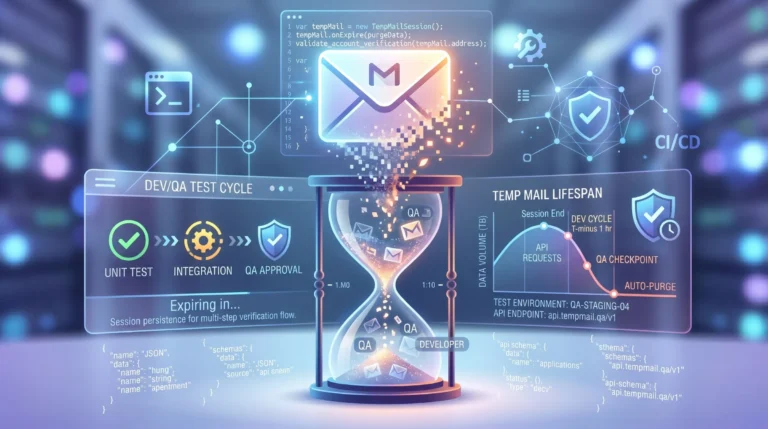
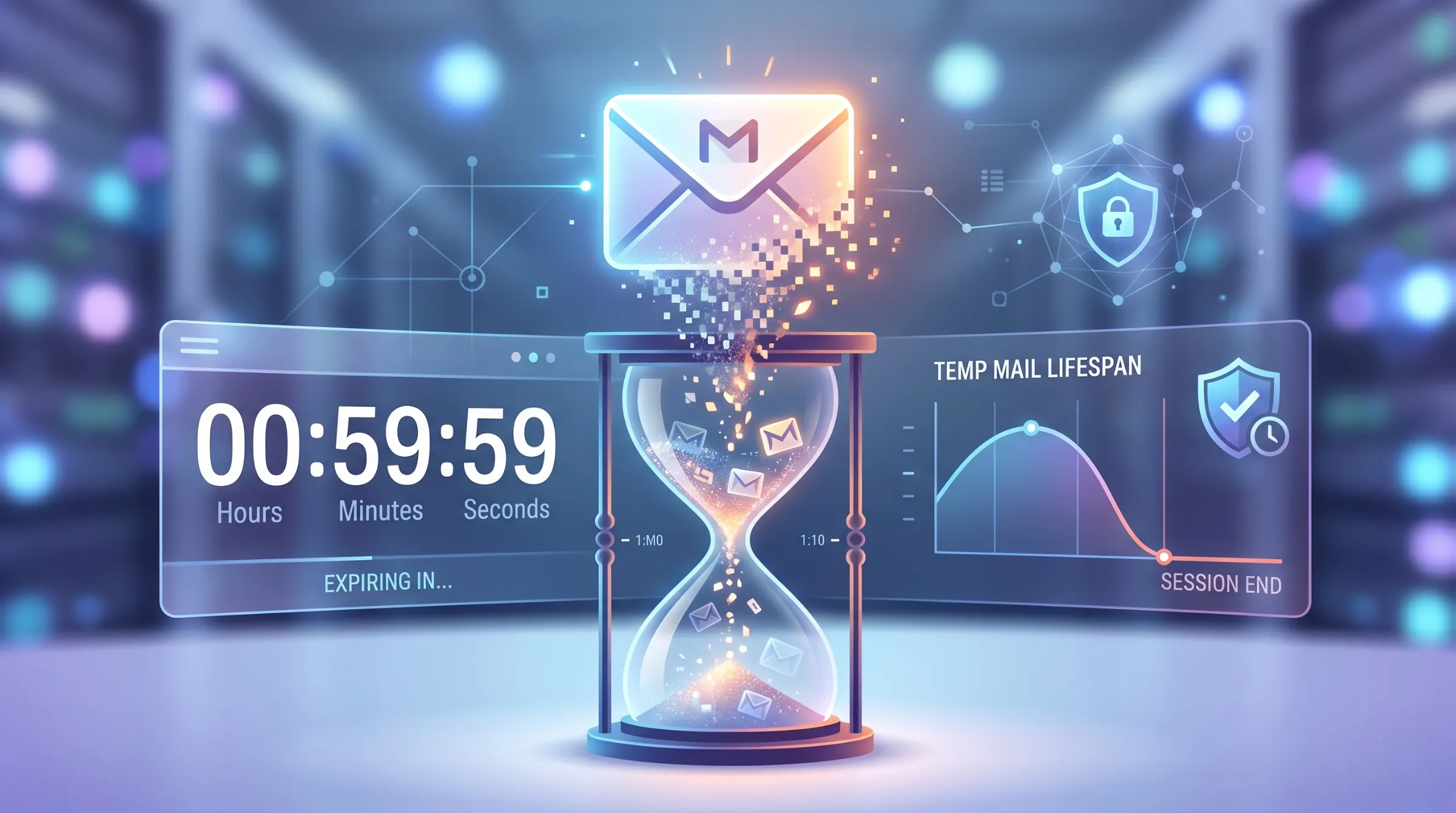
Under the hood, expiration is enforced server-side through timestamp-based deletion — the server records the exact creation time, calculates the expiration, and runs automated cleanup jobs every 30-60 seconds to purge expired addresses. The countdown timer you see in your browser is visual only – the server enforces the actual expiration regardless of what your browser displays.
Can You Extend Temp Mail Lifespan?
Some services offer a reset button – typically adding 10 more minutes, usually capped at 2-3 resets for a maximum of 20-30 minutes total. Others offer no extension at all, particularly security-focused providers with fixed lifespans.
The alternative is simply generating a fresh address with a new timer. Different address, clean slate, full window.
Some providers offer extended or permanent storage through premium plans, which is useful for QA testing, developer workflows, and ongoing verification needs.
Worth noting: unlimited extension defeats the purpose. If temp mail never expires, it’s not temporary – it’s just another email account. The time limit is what creates the privacy. Short expiration reduces tracking correlation, spam accumulation, and breach impact.
Best Practices Based on Inbox Lifespan
If your inbox lasts under 1 hour: Complete the entire verification immediately. Keep the tab open. Copy every code, link, and key to a password manager or notes app the moment it arrives. Don’t use this inbox for anything requiring a follow-up email.
If your inbox lasts 1-24 hours: You have a reasonable window but still treat it as time-sensitive. Complete the primary verification right away, then check back within the window for follow-ups. Copy critical content before closing the tab for the first time.
If your inbox lasts multiple days: More relaxed, but don’t mistake “days” for “indefinite.” Set a reminder before the window closes and still copy anything important.
The most common mistake is treating temp mail like a permanent inbox — signing up, closing the tab, and assuming you can return days later. For most providers, that assumption will cost you. Other frequent errors include not copying verification links immediately (these often have their own 24-72 hour expiration timers separate from the inbox), and using a short-lifespan inbox for a multi-day free trial.
For a deeper look at how temp mail lifespan affects traceability and anonymity, see our guide on can temp mail be traced.