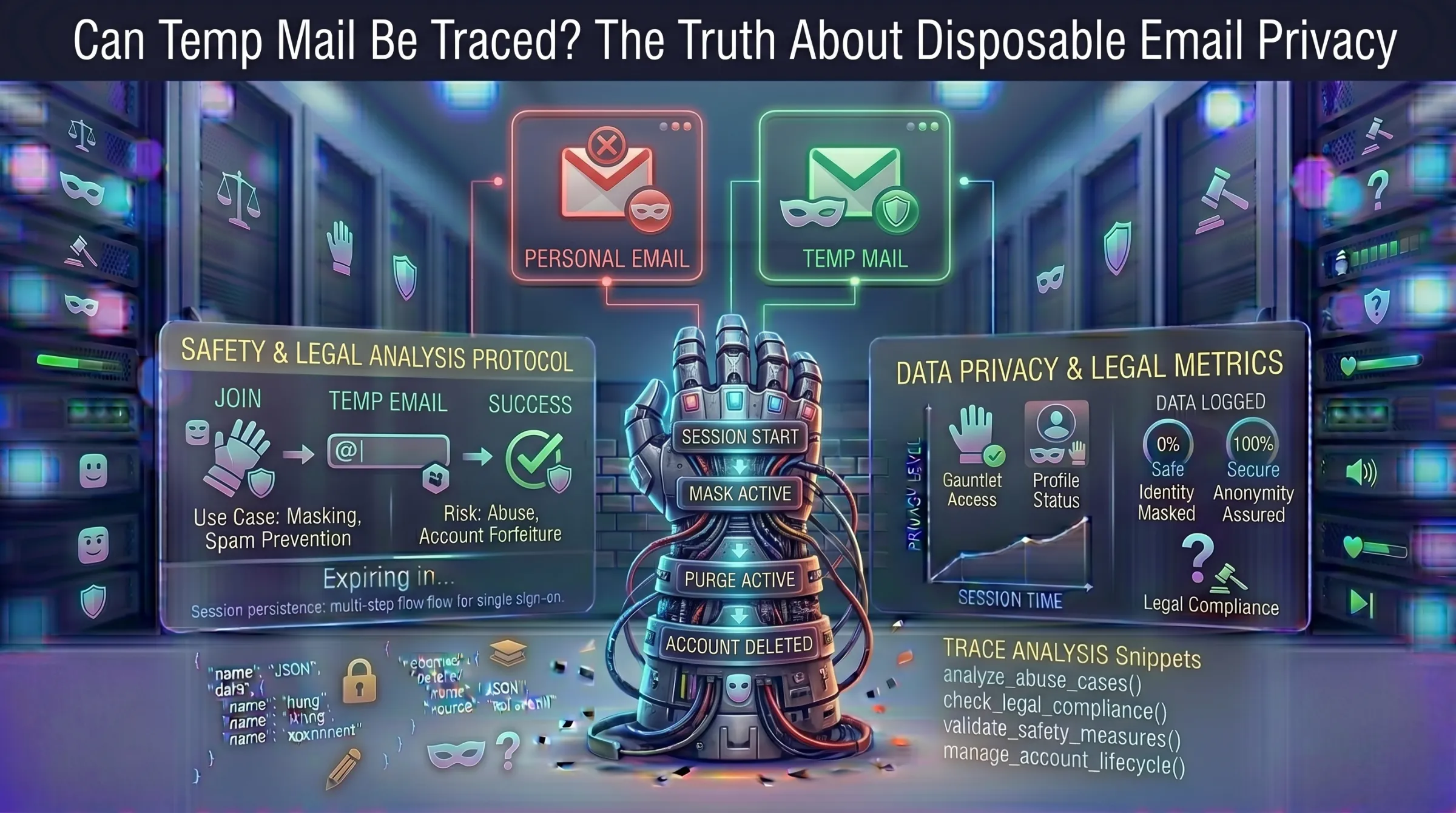
Can Temp Mail Be Traced? The Truth About Disposable Email Privacy
One of the most common concerns about using a disposable inbox is whether it can be traced back to you. If the whole point is anonymity, how anonymous are you actually?
The short answer: a temporary email address is significantly harder to trace than a regular email account — but it’s not invisible. Understanding what’s traceable, what isn’t, and where the gaps exist helps you use temp mail effectively without a false sense of invincibility.
What Makes Temp Mail Hard to Trace
No Personal Information Attached
Regular email accounts – Gmail, Outlook, Yahoo – require a name, phone number, and password during registration. All of that data is stored and linked to your identity. Temp mail requires none of it. No registration, no personal details, no account credentials. There’s simply nothing connecting the disposable address to a real person.
No Persistent Account
A standard email account exists indefinitely, accumulating years of messages, contacts, and activity logs. A temp address exists for hours — sometimes minutes — then auto-deletes along with every message in it. Once expired, there’s no inbox to investigate, no message history to subpoena, no account to access.
Minimal Data Retention
Reputable temp mail providers store almost nothing. No IP logs, no user profiles, no behavioral data. After the inbox expires, the data is purged. Even if someone wanted to trace the address, the information simply doesn’t exist on the provider’s servers anymore.
What Can Still Be Traced
Your IP Address at the Service Level
While quality providers like TempMail.chat don’t log IP addresses, your visit to the temp mail website is still visible to your ISP, network administrator, or anyone monitoring your connection. They can see that you accessed a temp mail service – they just can’t see which address you generated or what emails you received.
Email Headers
Every email contains headers that indicate routing information — which servers handled the message, timestamps, and sometimes partial origin data. While temp mail headers are generally less informative than regular email headers, they still carry some technical metadata that could be analyzed in a forensic investigation.
Your Behavior After Signup
This is where most people get caught. If you create a temp address, use it to sign up for a service, and then log into that service from your real IP address, the platform can track your activity through IP logs, device fingerprints, cookies, and behavioral patterns. The temp address protected your email identity- but your browsing behavior revealed your real identity anyway.
Legal Requests
In cases involving illegal activity or court orders, temp mail providers may be required to disclose whatever information they have. However, if the provider genuinely practices auto-deletion and no-logging policies, there may be little or nothing available to hand over. The temporary nature of the service limits what can be traced even under legal compulsion.
Temp Mail vs Regular Email: Traceability Comparison
Regular email accounts are highly traceable – they store personal registration data, years of message history, login IP logs, device information, and behavioral patterns. All of this is available to the provider and potentially to law enforcement through legal channels.
Temporary email addresses are significantly less traceable — no personal data on file, no persistent inbox, minimal or zero logging, and auto-deletion that removes evidence by design. The privacy gap between the two is substantial.
But “less traceable” is not “untraceable.” No online service provides complete anonymity. Temp mail reduces your digital footprint dramatically — it doesn’t eliminate it entirely.
How to Maximize Your Privacy with Temp Mail
Use a VPN alongside temp mail. A VPN masks your IP address, preventing your ISP and network from seeing that you visited a temp mail website. Combined with a disposable address, this covers both your email identity and your network identity.
Use a different temp address for every signup. If multiple services are linked to the same disposable address, someone could correlate activity across those services. One address per task keeps each interaction isolated.
Never enter personal information when using temp mail. If you register for a service with a temp address but provide your real name, phone number, or payment details, the anonymity of the email address becomes meaningless.
Don’t log into accounts from your real IP. If anonymity matters, access the account through a VPN or privacy browser — not from your home or work network.
Choose providers with clear no-logging policies. Not all temp mail services are equal. Some log IP addresses and retain metadata. Providers that explicitly state no-logging and auto-deletion offer stronger privacy protection. TempMail.chat collects no personal data and auto-deletes inboxes after 24 hours.
The Bottom Line
Temp mail is one of the simplest and most effective tools for reducing your traceability online. It eliminates the personal data that makes regular email accounts easy to trace – no name, no phone number, no password, no persistent history.
But it’s one layer of protection, not total invisibility. Your IP address, browser behavior, and the information you voluntarily provide to platforms all create separate traceability paths. For genuine anonymity, combine temp mail with a VPN, privacy-focused browsing, and careful information hygiene.For the complete picture on safety and legality, see our guide on whether temporary email is safe and legal.