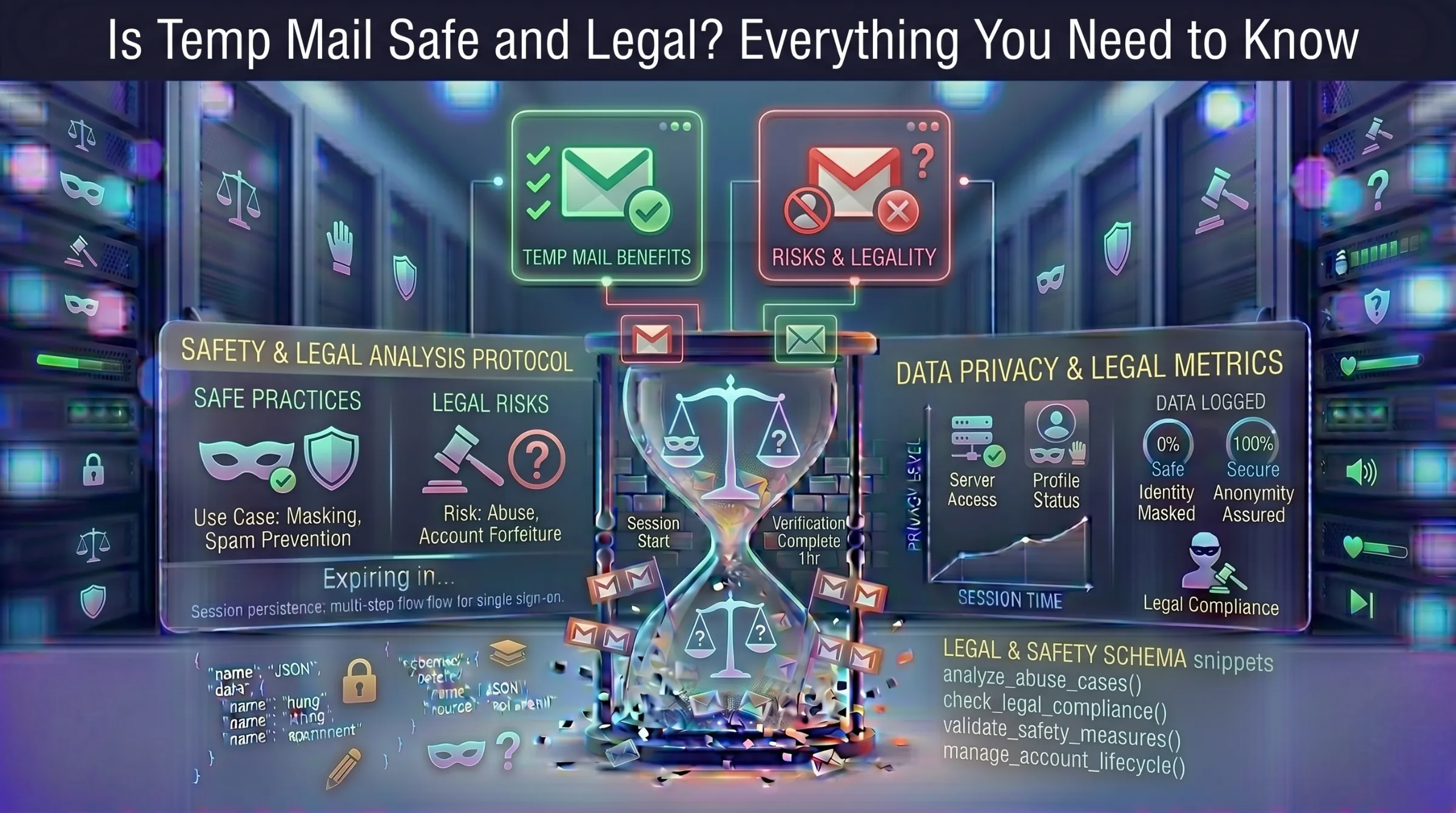
Is Temp Mail Safe and Legal? Everything You Need to Know
The two most common questions people ask before using a disposable inbox are simple: is it safe, and is it legal? The short answer to both is yes – with important caveats that determine whether temp mail protects you or creates new problems.
This guide covers the safety, legality, privacy, and ethical boundaries of using temporary email so you can make informed decisions about when and how to use it.
Is Temp Mail Safe?
For its intended purpose – yes. Reputable temp mail services operate over HTTPS encryption, perform no IP address logging, and require no registration or personal data. There’s no account to hack, no stored identity to leak, and no password to compromise.
However, “safe” has boundaries. Most temporary inboxes are publicly accessible to anyone who knows the address. Never use a disposable inbox for anything containing sensitive information — banking details, medical records, passwords, or private communications.
Temp mail is safe as a privacy shield for non-sensitive signups. It is not safe as a replacement for a secure, private email account.
Is Temp Mail Legal?
Using a disposable email address is legal in virtually every jurisdiction. It’s a privacy tool — no different from using a PO box instead of your home address. No law prohibits you from generating a temporary inbox to receive a verification code.
However, legality applies to the tool itself, not to everything you might do with it. Using temp mail to commit fraud, impersonate someone, steal intellectual property, bypass paid services, or create fake accounts that violate a platform’s terms of service can carry legal consequences — not because temp mail is illegal, but because the underlying action is.
GDPR, CCPA, and Privacy Regulations
Temp mail services operating in or serving users in the EU must comply with GDPR. In the US, CCPA applies in California. These regulations govern how providers handle whatever minimal data passes through their systems. Reputable providers store nothing beyond the temporary inbox contents, which auto-delete after expiration.
International Considerations
Laws vary by country. While disposable email is broadly legal, some jurisdictions have specific requirements around anonymous communication tools, particularly for business or legal correspondence. If you’re using temp mail for international matters, be aware of the rules in both your country and the countries of your correspondents.
Is Temp Mail Private?
It’s anonymous in the sense that no personal details are tied to the address. But “private” has real limits.
Your inbox may be visible to others during its active window if they know the address. Your ISP or network administrator can see that you visited a temp mail website. And while the provider doesn’t log your IP, your browser, network, and the platforms you sign up for may still track your activity through other means.
For stronger privacy, combine temp mail with a VPN to mask your network activity alongside your email identity.
Can Temp Mail Be Traced?
The address itself isn’t linked to your real identity. No name, no phone number, no account credentials connect you to the disposable inbox.
But traceability isn’t just about the email address. If you create an account with a temp address and then log into that account from your real IP, the platform can track your activity through IP logs, device fingerprints, and behavioral patterns. Temp mail protects your email identity — not your entire digital footprint.
For a deeper dive, see our dedicated guide on whether temporary email can be traced.
What Happens If a Provider Gets a Legal Request?
Temp mail providers can receive subpoenas or court orders demanding user information. The key question is: what data exists to hand over?
Reputable providers with true auto-deletion policies retain almost nothing. Once the inbox expires, emails are purged, metadata is cleared, and no user profile exists to disclose. Providers that log IP addresses, retain messages beyond expiration, or store user activity create a larger surface for legal discovery.
Before choosing a provider, review their data retention policy. The less data they keep, the less data exists to be requested. TempMail.chat requires no registration, stores no personal data, and auto-deletes inboxes after 24 hours.
The Ethical Middle Ground
Temp mail exists for legitimate privacy protection. The responsible use cases are clear:
- Avoiding spam from non-essential signups
- Protecting your real email from data breaches
- Staying anonymous on forums and communities
- Testing applications and services
- Downloading gated resources without marketing follow-up
The ethical line is equally clear. Using temp mail to abuse free trials at scale, impersonate others, harass users, bypass security measures, commit fraud, or evade platform bans crosses from privacy into misuse. The tool doesn’t make the action legal — your intent and behavior determine the consequences.
Platform Terms of Service
Most websites have policies regarding disposable email addresses. Some explicitly prohibit them, others impose limitations, and many simply filter known disposable domains without stating a formal policy.
Using temp mail on a platform that prohibits it won’t result in criminal liability but it can result in account suspension, termination, or loss of access. Always consider whether the platform’s terms allow disposable addresses before relying on one for anything important.
For more on how specific platforms handle temp mail, see our guides on temp mail for Facebook and temp mail for Discord.
When to Use Temp Mail and When Not To
Safe and appropriate for: forum signups, software trials, download gates, newsletter subscriptions, one-time verifications, loyalty card signups, online giveaways, QA testing, any service you don’t fully trust with your real address.
Not appropriate for: banking, medical accounts, government services, employment communication, legal correspondence, any account requiring long-term recovery access, any activity intended to deceive or defraud.
A free disposable inbox is one of the simplest privacy tools available. Use it for what it’s designed for, respect the boundaries, and it serves you well without any legal risk.