Data Breaches and Your Email – How to Stay Safe
Your email address is the single most reused credential on the internet. Every signup, every account, every service – all tied to one address. When any of those services gets breached, your email and everything associated with it is exposed to hackers, data brokers, and phishing operations.
The risks aren’t hypothetical. Billions of email addresses have appeared in publicly leaked databases over the past decade. Understanding how regular email accounts put you at risk and how temporary email eliminates most of those risks by design – is the first step toward protecting yourself.
Why Regular Email Accounts Are a Privacy Risk
Data Mining and Targeted Advertising
Most free email providers monetize by scanning your email content. Your communication patterns, interests, purchase confirmations, and personal details become data profiles used for targeted advertising. What providers frame as “data aggregation for marketing” is effectively your private correspondence being turned into a product sold to advertisers – often without you fully understanding the scope.
SMTP Wasn’t Built for Security
The core email protocol – SMTP – was designed for reliability, not security. Without additional encryption layers, emails can be intercepted during transmission. Most free providers now encrypt emails in transit, but they decrypt and store them in readable form on their own servers. That means the provider itself, its employees, hackers who breach the server, or legal authorities who issue a request can all potentially access your messages.
End-to-End Encryption Is Rarely the Default
True end-to-end encryption means only the sender and recipient can read the message — not even the provider. Most regular email services do not offer this by default. Your emails sit on provider servers in a form the company can read, index, and if compelled, hand over.
How Data Breaches Expose Your Email
What Happens When a Service Gets Hacked
When a website you registered with is breached, your email address, password, and associated account data end up in leaked databases. These databases circulate freely among hackers and data brokers. Your email becomes the key that unlocks phishing attempts, credential stuffing attacks, and identity theft — not just on the breached service, but across every service where you used the same address.
Long-Term Data Retention Makes It Worse
Even after you delete emails or close an account, many providers retain copies of messages and metadata for extended periods. This long retention window means old data can surface in future breaches years after you thought it was gone. And truly deleting an account with all its data is often far more complex and time-consuming than providers suggest.
Cross-Platform Tracking Amplifies Exposure
Regular email accounts are integrated with browsers, apps, cloud storage, and other services. Your email usage becomes part of a broader behavioral profile — browsing history, app activity, location data, purchase patterns — all linked through one address. A breach doesn’t just expose your emails. It exposes your entire connected digital footprint.
The Real-World Threats You Face
Phishing and Social Engineering
Breached email addresses become immediate phishing targets. Attackers impersonate banks, employers, or services they know you use — because the breach data told them exactly which platforms your email is registered with. These emails are convincing enough to steal credentials, install malware, or trick you into transferring money.
Government Surveillance and Legal Requests
Email providers can be compelled to hand over user data to authorities, often without user consent or notification. Mass surveillance programs routinely collect and store email communications at scale, raising serious civil liberties concerns – particularly when the provider stores your emails in readable form on their servers.
Identity Theft and Credential Stuffing
Once your email appears in a breach database, attackers automatically try the same email-password combination across hundreds of other services. If you reused passwords – which most people do – one breach cascades into many compromised accounts.
This is exactly why understanding whether temporary email can be traced matters for anyone serious about protecting their online identity.
How Temporary Email Protects You from Breaches
No Personal Information to Expose
A free disposable inbox requires zero personal data – no name, no phone number, no password, no identity verification. If a service you signed up with gets breached, there is nothing connecting that disposable address back to your real identity.
Limited Lifespan Eliminates Long-Term Risk
Temporary addresses auto-expire. Even if someone obtains the address from a leaked database months later, the inbox no longer exists. There are no stored emails to access, no account to compromise, no data to mine. Learn more about how temporary email expiration works and why auto-deletion is a privacy feature, not a limitation.
No Email Scanning or Data Mining
Disposable email services don’t monetize through advertising. There is no content scanning, no user profiling, no behavioral data collection. Your emails exist only until they expire — they are never indexed, analyzed, or sold.
No Cross-Platform Tracking
A temp address isn’t linked to your browser, your apps, your location, or your real identity. It exists in complete isolation — used once and discarded — breaking the chain that cross-platform tracking depends on.
Breach Impact Reduced to Zero
When a disposable address appears in a breach, the damage is functionally zero. No real identity attached. No password to reuse. No inbox to access. No profile to exploit. The address has already dissolved.
When to Use Temp Mail vs Regular Email
Not every situation calls for a disposable address. Here’s how to decide:
Use temporary email for forum signups, free trial activations, download gates, newsletter subscriptions, one-time verifications, loyalty card signups, online giveaways, and any service you don’t fully trust with your real address.
Use your regular email for banking, medical accounts, employment communication, government services, and any account requiring long-term password recovery access.
Use a privacy-focused provider for ongoing communication where you need both persistence and strong security — services offering end-to-end encryption by default.
For a detailed comparison of disposable addresses versus permanent privacy tools, see our guide on temporary email vs email aliases.
Practical Steps to Protect Your Email Today
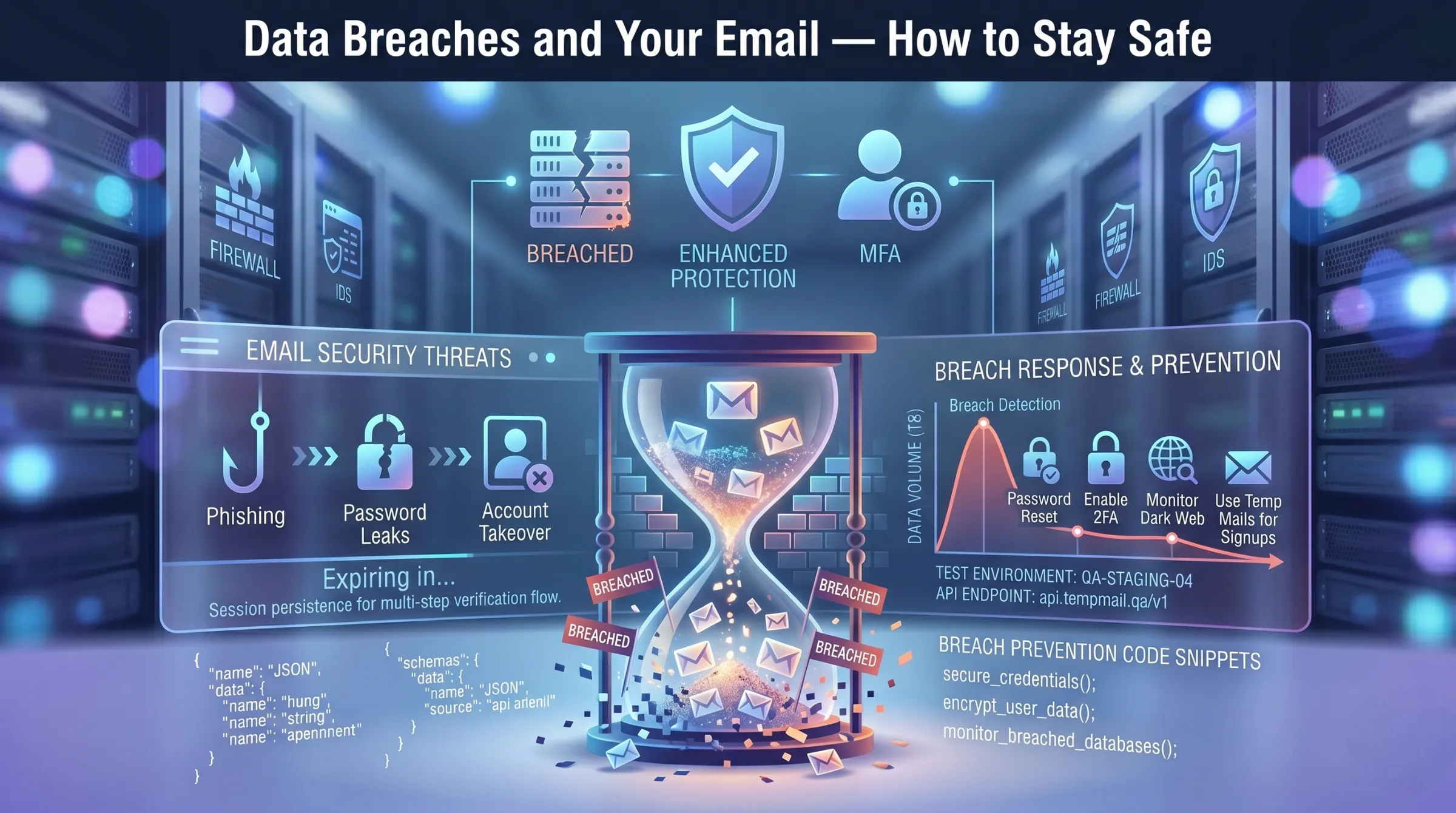
Use a disposable temporary address for every non-essential signup — this alone eliminates the majority of breach exposure. Beyond that, never reuse passwords across services and use a password manager to generate unique credentials for every account.
Enable two-factor authentication on your primary email. Check whether your address has already appeared in known breaches using a breach-checking tool. Avoid clicking links in unexpected emails — always verify the sender independently through a separate channel.
Review your email provider’s data retention and privacy policies. Consider switching to a privacy-focused provider for sensitive personal and business communication. And periodically audit which services have your real email address – unsubscribe and delete accounts you no longer use.
The less your real email address exists across the internet, the smaller your attack surface becomes. For every signup that doesn’t need your real identity, a temporary address is the simplest and most effective protection available.